
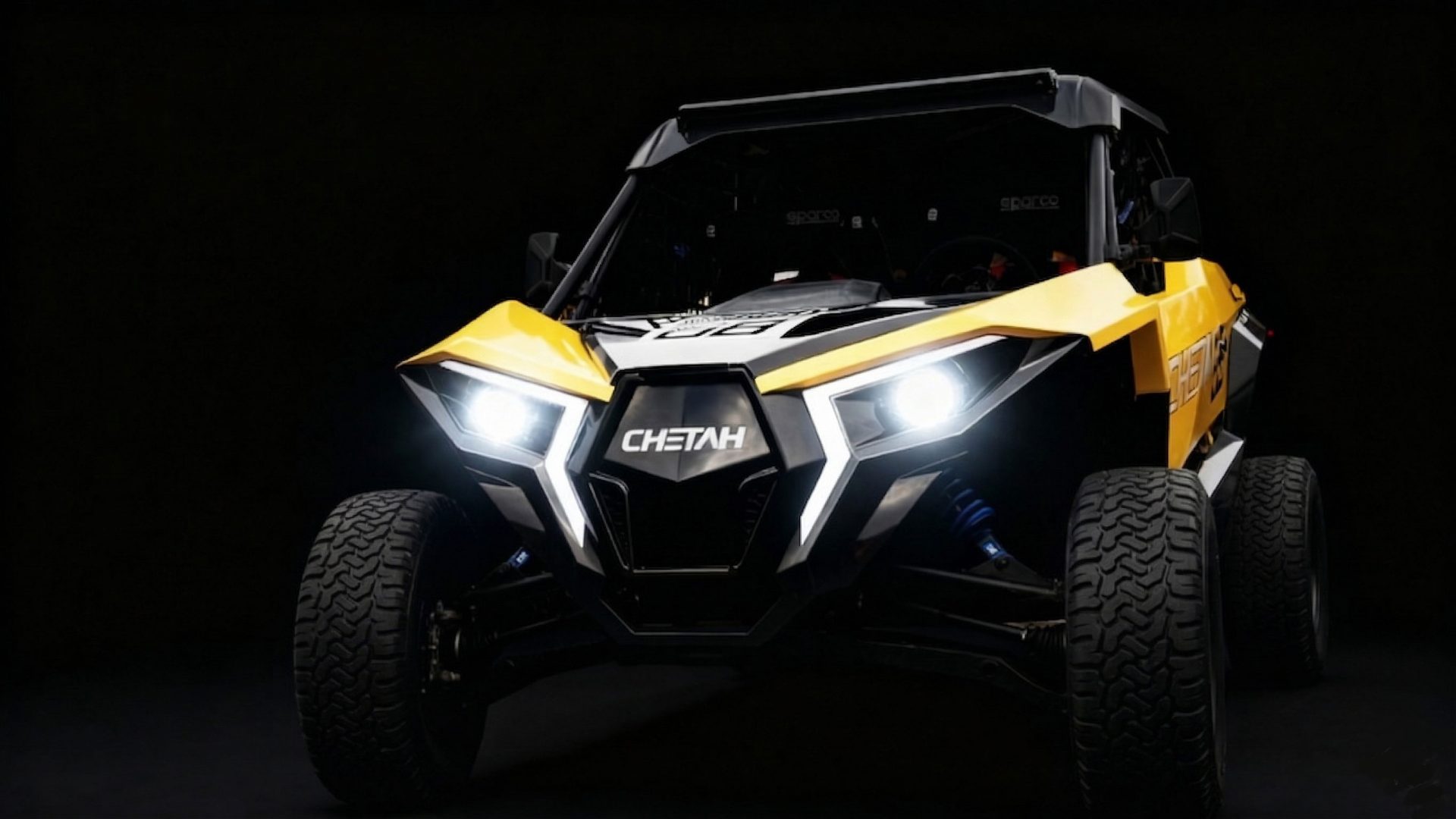
Torque Is Justice: How the CHEETAH Electric Off-Road Racing UTV Redefines Performance Boundaries with 480 N·m
In the world of off-road racing, an old saying is repeated time and again: “Horsepower sells cars, but torque wins races.” This was already gospel in the fuel era—but in the electric age, it has become a devastating, game-changing advantage
When a UTV can deliver 480 N·m of peak torque to the wheels, and release it instantly the moment you step on the throttle, it changes far more than just “accelerating a bit faster.” It fundamentally rewrites the competitive logic of offroad racing
1. What Is Torque, and Why Is It More “Lethal” Than Horsepower?
For most consumers, “horsepower” is an easier number to grasp—it represents how much work an engine can do. But on an offroad track, the true determinant of whether a vehicle can conquer steep climbs, blast out of corners ahead of rivals, or creep through rock gardens is torque
Torque is, in essence, rotational force. You can think of horsepower as a boxer’s “total punching energy,” while torque is the “instantaneous impact of the fist on the face.” In offroad racing, where vehicles must overcome gravity, mud resistance, and sudden terrain changes, that instantaneous impact often matters more than the total energy
Fuel engines have a fatal flaw in torque delivery: they need revs. A competitive fuel-powered UTV engine typically reaches its peak torque only between 3,000 and 5,000 rpm. That means from the moment you press the throttle to the moment you get maximum torque, there is an unavoidable waiting window—a time lag in power response
Electric motors operate on a completely different principle. They deliver peak torque from zero rpm. Within milliseconds of pressing the pedal, full torque is already reaching the wheels. This is not a minor technical optimisation—it is a fundamental difference in physics
2. What Does 480 N·m Really Mean?
The CHEETAH is equipped with dual permanent-magnet synchronous motors. Each motor delivers 240 N·m peak torque, and together they produce a combined total of 480 N·m
To appreciate this number, we need to place it in the context of UTVs. Today, a mainstream 1000cc fuel-powered UTV typically produces around 80–100 N·m of peak torque at the engine. Even top-tier turbocharged performance UTVs rarely exceed 150 N·m. The CHEETAH’s 480 N·m is three to six times larger than these figures
More importantly, a fuel UTV’s torque must pass through a CVT transmission before reaching the wheels—a process that not only incurs energy losses but, more critically, introduces interruptions and delays in power delivery. The CHEETAH, by contrast, uses a direct-drive architecture: the motors drive the drivetrain directly, with an extremely short power path and near-zero losses
In 0-100 km/h acceleration tests, the CHEETAH achieves under 4 seconds—supercar-level performance, yet delivered by an offroad UTV with a kerb weight of just 1,120 kg
3. Three “Dominance Moments” on the Track
Impressive torque numbers only matter if they translate into track performance. The CHEETAH’s 480 N·m completely overpowers fuel UTVs in the following three critical scenarios[cite: 1]:
- Race Start: The Race Is Won in 0.3 Seconds. From a standing start, a fuel UTV driver must “build revs.” This takes 0.3 to 0.5 seconds. The CHEETAH driver simply presses the pedal, and 480 N·m arrives at the wheels instantly
- Corner Exit: The Apex Decides the Race. A fuel UTV brakes, downshifts, then accelerates out of the corner—waiting for revs to climb again—creating a noticeable “response gap.” The CHEETAH, with its dual-motor four-quadrant torque control, delivers power almost as soon as the steering wheel is straightened
- Jump Landing: Accelerate the Moment You Touch Down. When a fuel UTV lands, engine revs often drop far from the optimal torque band. The CHEETAH instantly delivers the required torque upon landing, with no “rev-matching” delay
4. The Hidden Edge of Dual Motors: Torque Vectoring
The total 480 N·m torque has another killer feature—it can be distributed independently to the left and right wheels. The CHEETAH’s dual-motor independent drive allows torque to be controlled separately for each side. In corners, the system can send more torque to the outside wheel and less to the inside, actively helping the vehicle turn—this is known as torque vectoring
In a fuel UTV, achieving a similar effect relies on mechanical differential locks and complex traction-control systems, which are far slower and less precise than an electronic solution. The CHEETAH’s motor controller monitors each wheel’s slip rate hundreds of times per second and adjusts torque distribution in real time—effectively giving each wheel its own dedicated power source
5. When Torque No Longer Needs to Wait
The competitive advantages that fuel UTVs have built up over a century are rapidly being eroded by electric platforms. Because electric platforms deliver a physical advantage that fuel will never match: full torque from zero rpm, with zero waiting
The CHEETAH’s 480 N·m is more than just a number. It represents a new racing philosophy: replace lag with instant force, replace crude machinery with precise electronics