
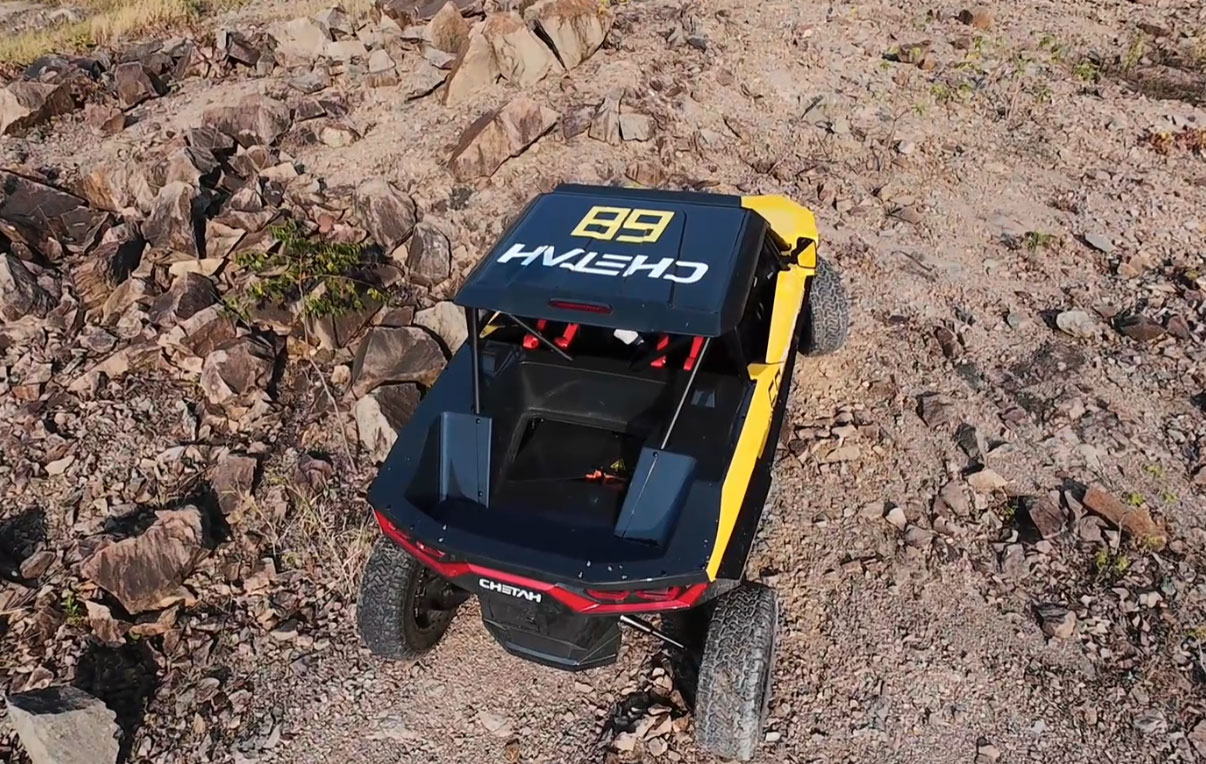
In the off-road world, “environmentally friendly” and “high performance” were once irreconcilable opposites. The roar of a fuel engine was seen as the very soul of off-road spirit, while the resulting emissions were accepted as the inevitable price of adrenaline.
But times have changed.
When the Dakar Rally—the gold standard of global motorsport—introduced its new “Mission 1000” category in 2024, offering a dedicated stage for next-generation carbon-neutral powertrains including pure electric and hydrogen vehicles; and when the Extreme E series has been running wheel-to-wheel racing with electric SUVs in the world’s most remote and fragile environments since 2021, maintaining carbon-neutral operations throughout—a clear signal has been sent around the world: the green revolution in off-road racing has officially begun.
1. Zero Emissions: From Polluter to Solution
Every time a conventional fuel-powered UTV charges down the track, it pumps carbon dioxide, nitrogen oxides, and fine particulates into the air. A single high-performance off-road UTV can emit as much over one race as dozens of passenger cars produce in an entire day. And when these vehicles operate in nature reserves, deep desert, or forested areas, the cumulative impact of their emissions on fragile ecosystems is far from negligible.
The CHEETAH provides a definitive answer: zero tailpipe emissions.
With its high-energy-density prismatic ternary lithium battery pack and 800V high-voltage platform, the CHEETAH produces no harmful gases during every acceleration, every jump, every flat-out lap. For event organisers facing increasingly stringent environmental regulations, for off-road activities in protected natural areas, and for racing brands pursuing “carbon-neutral” credentials—the CHEETAH is no longer a polluting asset to be “tolerated”; it is a positive solution.
Moreover, battery recyclability is becoming a key part of the industry’s closed-loop economy. The CHEETAH’s prismatic lithium-ion battery design has considered second-life applications and recycling pathways from the outset—once its racing career is over, the battery can continue to provide value in energy storage and other fields, rather than becoming an environmental burden.
2. Low Noise: Letting Off-Road Return to Nature
Fuel UTVs often exceed 100 decibels. In quiet forests or open wilderness, a single machine’s roar can cover several square kilometres. This not only disturbs wildlife but also heightens conflicts between off-road activities and local communities.
The CHEETAH’s electric powertrain delivers a revolutionary quiet experience. Electric motor noise is far lower than that of an internal combustion engine—there are no exhaust bangs, no mechanical clatter from transmissions. On the track, drivers can hear tyre squeal and suspension feedback much more clearly—sounds that are often drowned out by the din of a fuel vehicle.
Beyond the track, low noise means fewer community complaints, more flexible operating hours, and a more harmonious relationship between people, vehicles, and nature. When off-roading no longer carries the stigma of “noise pollution,” the sport’s appeal can broaden significantly.
3. High Efficiency: More Track, Less Carbon Footprint
Being green is not just about “how much you emit”—it is also about “how many resources you consume to finish the race”.
Fuel UTVs typically have energy conversion efficiencies of only 20–30%—most of the fuel’s energy is wasted as heat. In contrast, the CHEETAH’s electric drive system achieves an efficiency of over 90%, meaning that for the same track distance, it consumes far less primary energy than a fuel vehicle.
What does this mean in practice? In endurance races, the CHEETAH can complete the same race distance with less energy reserve. In race logistics, fewer fuel trucks and containers are needed. Over the full “well-to-wheel” lifecycle, the carbon footprint of the CHEETAH is dramatically lower than that of its fuel counterparts.
Combined with the CHEETAH’s modular rapid-swap battery system, event organisers can replenish energy in just a few minutes—without the need to transport and store large quantities of flammable fuel. Safer, cleaner, and more efficient.
4. Policy Tailwinds: Green Is Not a Choice—It Is the Direction
Environmental responsibility is no longer just a matter of conscience; it is increasingly a hard requirement for market access.
In 2026, China has clearly included new-energy vehicles as a key component of the green transformation in the transport sector. From the “green, low-carbon, intelligent, safe” theme of NEV promotion campaigns to the implementation of traffic-restriction exemptions and priority road rights, and from provincial subsidies (e.g., nearly 190 million yuan in Zhejiang alone) to supportive policies, the policy dividends for electrification are accelerating.
The same trends apply to off-highway vehicles. The U.S. EPA’s revisions to the nonroad vehicle regulations are tightening emissions limits and accelerating the phaseout of inefficient engines. Globally, the shift toward manufacturing electric ATVs and UTVs to reduce fossil fuel consumption, noise, and emissions has become one of the clearest industry directions.
For race organisers, clubs, and teams, choosing the CHEETAH means not only choosing performance, but also choosing a path aligned with regulatory direction—one that brings lower compliance risks, longer operational life, and greater market opportunity in an era of ever-stricter environmental laws.
5. A Green Manifesto on the Track
The CHEETAH is not a compromise built for “environmental friendliness” at the expense of performance.
It delivers 480 N·m of dual-motor peak torque, a sub-4-second 0-100 km/h sprint, a top speed of 180 km/h, and CDC electronically controlled active damping for precise handling. These numbers prove one thing: zero emissions, zero performance loss.
When the CHEETAH blasts down the track, it leaves behind no acrid exhaust fumes or deafening roar—only a quiet, swift green streak of lightning. It declares to the world that off-road passion need not come at the cost of the environment, and that racing glory can coexist with the future of our planet.
From Dakar to the King of the Hammers, from Extreme E to the COC NEV category, electric off-road racing is accelerating worldwide. The CHEETAH stands at the vanguard of this transformation—using its tube-frame chassis for lightweight efficiency, its 800V platform for higher energy efficiency, its dual-motor direct drive to eliminate drivetrain losses, and every zero-emission lap to prove that green off-roading is not the future—it is now.
The fuel era will eventually close, and the electric off-road chapter is being written by the CHEETAH.